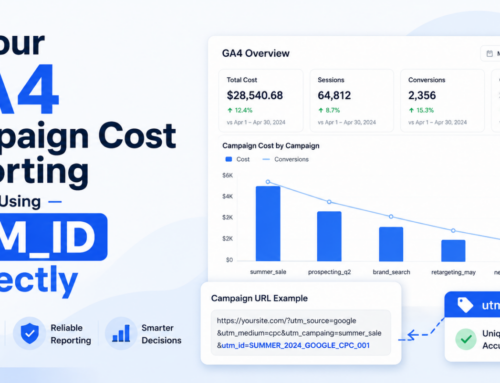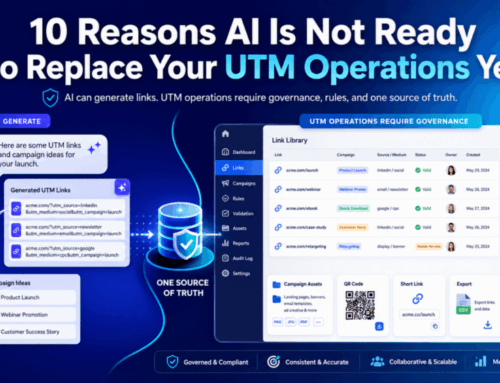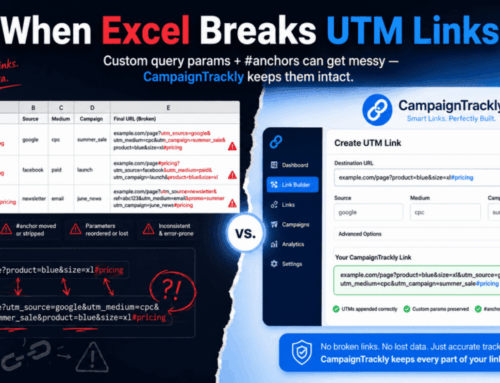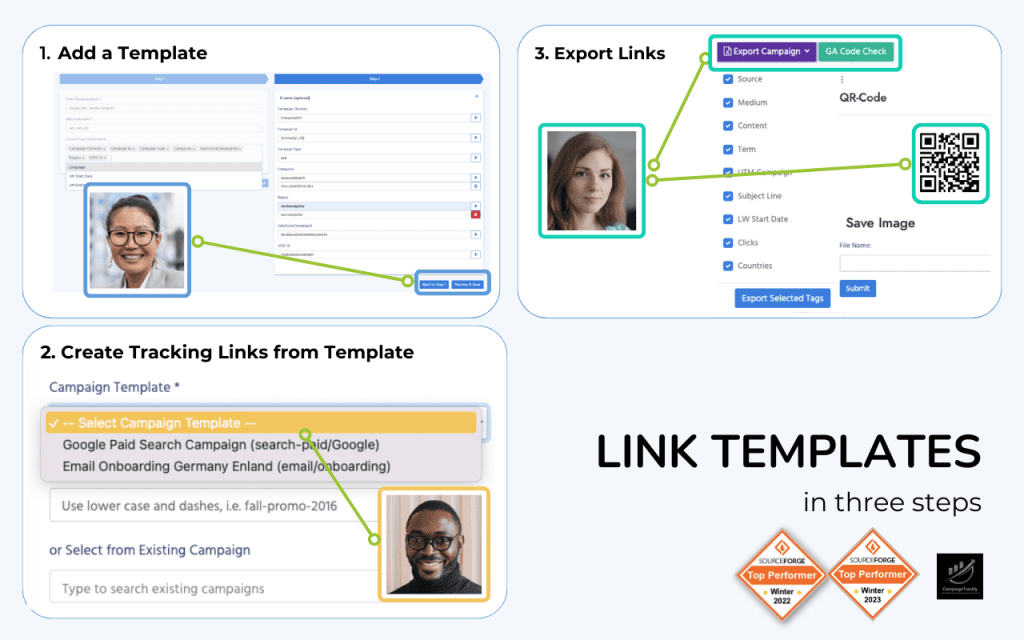
This guide gives you a quick and easy way to mastering marketing campaign naming conventions
Most marketing teams think of campaign naming conventions as a small operational detail. In reality, they are the foundation of reliable marketing analytics.
What Are Marketing Campaign Naming Conventions?
Marketing campaign naming conventions are structured rules that standardize how the names of campaigns, channels, tactics, and assets are formatted.
To get clean reporting, you must apply your Taxonomy (what you track) through a Convention (how you write it) to create a Name (the result).
The Difference: Name vs. Naming Convention
Why You Need Both for Campaigns, Tactics, and Variants
1. The Campaign Level
- The Taxonomy: We need to track the Fiscal Year and Marketing Goal.
- The Convention: [Year]_[Goal]
- The Name: 2026_Retention
2. The Tactic Level (The “How”)
- The Taxonomy: We need to track the Channel and the Audience Segment.
- The Convention: [Campaign Name]_[Channel]_[Audience]
- The Name: 2026_Retention_Email_ChurnedUsers
3. The Variant Level (The “Details”)
- The Taxonomy: We need to track the Creative Version and CTA Type.
- The Convention: [Tactic Name]_[Creative]-[CTA]
- The Name: 2026_Retention_Email_ChurnedUsers_V2-Discount
4. The Reporting Outcome
When you follow a Convention, your reporting tool (like Google Analytics or PowerBI) can take a messy string and turn it back into clean columns:
- Raw Name: SUMMER26_FB_VIDEO_US
- The Convention (The Rules): [CAMPAIGN]_[CHANNEL]_[FORMAT]_[GEO]
- The Report (The Result):
- Column 1 (Campaign): Summer 2026
- Column 2 (Channel): Facebook
- Column 3 (Format): Video
- Column 4 (Geo): USA
Because everything is in neat columns, you can easily slice and dice your data for in-depth analytics.
Why Campaign Naming Conventions Matter for Marketing Analytics
Due to today’s digital world complexities, modern marketing teams execute across email, paid social, organic social, search, display, and many other promotional channels. As a result, naming structure and formatting are essential. Without clear formatting standards, reporting quickly breaks down.
- Duplicate campaign names appear across platforms.
- Traffic is misclassified in analytics tools.
- Teams cannot compare performance accurately.
- Executives lose confidence in the data.
✨ What Happens When Campaign Naming Is Inconsistent
For example, the same initiative may appear as three separate campaigns in analytics tools simply because teams used different naming formats.
Over time, this creates reporting confusion, misclassified traffic, and unreliable attribution.
✨ Why Clean Naming Conventions Improve Attribution
Mastering marketing campaign naming conventions ensures that every campaign, channel, and creative asset follows a consistent structure.
Subsequently, this allows organizations to have standardized reporting data that enables both AI and dashboards to provide accurate insights.
Omnichannel Reporting And How Names Tie to It
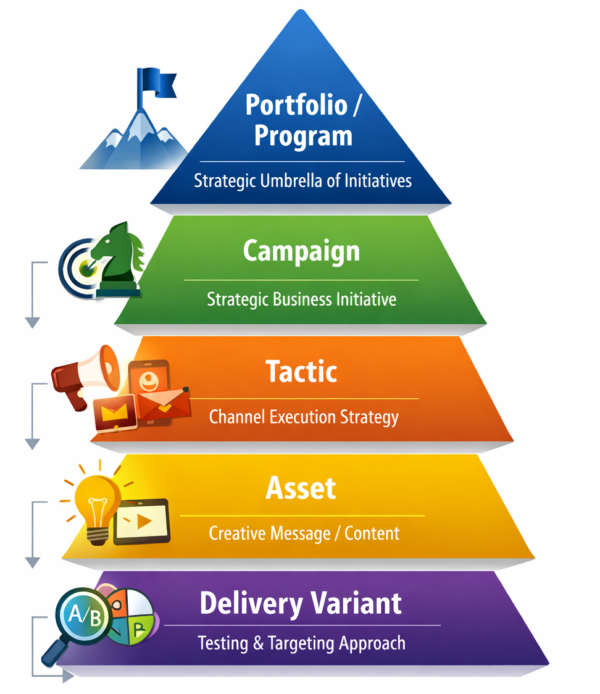
Effective Omnichannel Reporting Relies on Strong Frameworks
| Layer | Purpose |
|---|---|
| Portfolio/Program | Defines the strategic umbrella (theme or initiative grouping multiple campaigns) |
| Campaign | Defines the strategic business initiative. |
| Tactic | Defines how the campaign is executed in a specific channel. |
| Asset | Defines the creative message or content object. |
| Delivery Variant | Defines how the asset was delivered, tested, or targeted. |
Why Campaign Names Are Critical to Get Right In This Context
Campaign names are the most complex component in the hierarchy. They capture the business identity of the initiative.
- The same campaign may run across multiple channels – email, paid social, and more.
- It can encompass multiple countries, quarters and products.
- It might have dozens of assets and many asset variants.
But the campaign name itself should remain constant.
Recommended campaign name taxonomy:
How it shows in your reports following a well-defined convention:
The campaign name supports reporting rollups by quarter, geography, business unit, category, brand, product, audience, and campaign theme. It also allows granular data slicing by tactics, assets, and variants.
Omnichannel Reporting Structure Example
The table below shows how the same campaign can be executed across Email, Paid Social, and Organic Social without fragmenting performance reporting.
| Layer | Email Example | Paid Social Example | Organic Social Example |
|---|---|---|---|
| Portfolio/Program | Cardiovascular_Prevention | Cardiovascular_Prevention | Cardiovascular_Prevention |
| Campaign | 2026_Q2_NA_US_HealthTech_Cardiology_VitaPulse_VPMonitor_HCP_PreventionAwareness | 2026_Q2_NA_US_HealthTech_Cardiology_VitaPulse_VPMonitor_HCP_PreventionAwareness | 2026_Q2_NA_US_HealthTech_Cardiology_VitaPulse_VPMonitor_HCP_PreventionAwareness |
| Tactic | email_cardiology_sfmc_journey_prevention_awareness_touch1_202604 | paid_social_cardiology_linkedin_prevention_awareness_touch1_202604 | organic_social_cardiology_facebook_prevention_awareness_touch1_202604 |
| Asset | mktg_email_improve_patient_outcomes_v1 | promoted_post_prevention_awareness_message_v1 | page_post_prevention_awareness_message_v1 |
| Delivery Variant | M_SL1_cardiology_low-v-writers | campaign_id_adgroup_id_ad_id_cardiology_low-v-writers | imagevariant1_copyvariant1_cardiology_low-v-writers |
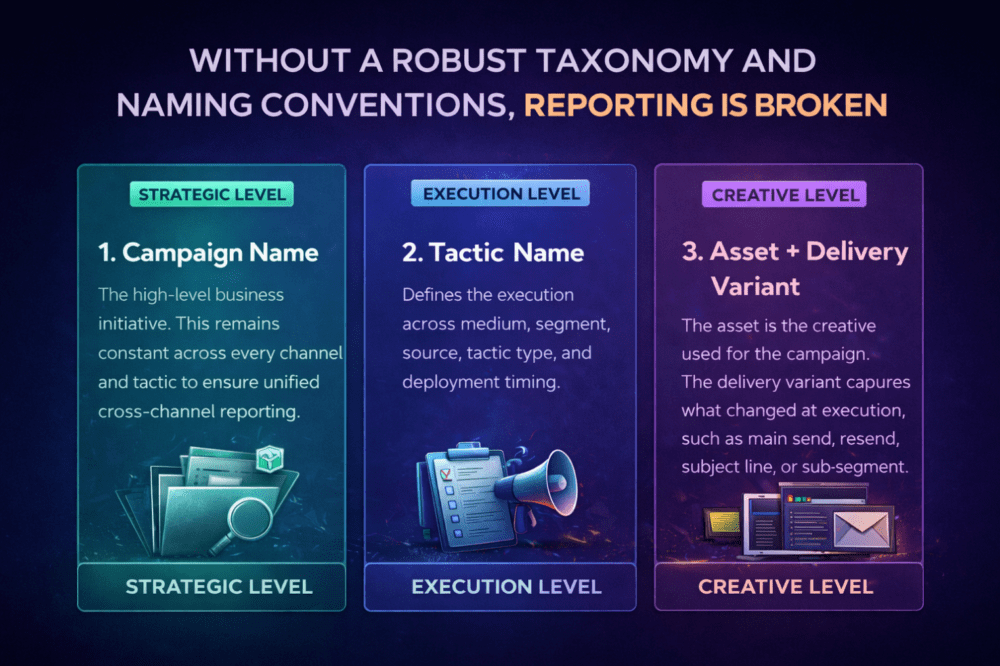
The 3 Main Marketing Artifacts Requiring Campaign Naming Conventions
Master the fundamental layers of campaign data governance
1. Campaign Name
The high-level business initiative. This remains constant across every channel and tactic to ensure unified cross-channel reporting.
2. Tactic Name
Defines the execution across medium, segment, source, tactic type, and deployment timing.
3. Asset + Delivery Variant
The asset is the creative used for the campaign. The delivery variant captures what changed at execution, such as main send, resend, subject line, or sub-segment.
2026_q2_na_us_healthtech_cardiology_vitapulse_vpmonitor_hcp_prevention_awareness
Tactic:
email_cardiology_sfmc_journey_prevention_awareness_touch1_202604
sms_cardiology_sfmc_journey_prevention_awareness_touch2_202604
Asset:
mktg_email_improve_patient_outcomes_v1
Delivery Variant:
m_sl1_cardiology_low-v-writers
Tactic Naming Convention Examples
Campaign:
| Channel | Tactic Example | Asset Example | Delivery Variant Example |
|---|---|---|---|
| email_cardiology_sfmc_journey_prevention_awareness_touch1_202604 | mktg_email_improve_patient_outcomes_v1 | M_SL1_cardiology_low-v-writers | |
| Paid Social | paid_social_cardiology_linkedin_prevention_awareness_touch1_202604 | promoted_post_prevention_awareness_message_v1 | campaign_id_adgroup_id_ad_id_cardiology_low-v-writers |
| Organic Social | organic_social_cardiology_linkedin_prevention_awareness_touch1_202604 | organic_post_prevention_awareness_message_v1 | imagevariant1_copyvariant1_cardiology_low-v-writers |
Asset Naming Conventions Examples
Asset names should describe the creative message, not the channel execution details. That keeps assets reusable across multiple tactics and delivery variations.
| Asset Class | Example | Meaning |
|---|---|---|
| mktg_email | mktg_email_improve_patient_outcomes_v1 | Marketing email creative |
| rep_email | rep_email_followup_discussion_v1 | Rep-driven communication |
| med_email | med_email_new_study_results_v1 | Medical or scientific communication |
| mktg_sms | mktg_sms_prevention_awareness_message_v1 | Marketing sms copy |
*Why versions are important: marketing or legal periodically review and update the assets, so it is important to track which version is currently in play to assess asset effectiveness.
Delivery Variants Examples
Delivery variants should reflect the metadata that actually changes at deployment time.
Paid Social
| Paid Social Sub-Column | Example Value | Purpose |
|---|---|---|
| Campaign ID | campaign_id | Identifies the paid campaign. |
| Ad Group / Ad Set | adgroup_id | Captures the ad grouping or set. |
| Ad / Creative ID | ad_id | Captures the specific ad or creative. |
Organic Social
How Campaign Naming Conventions Connect to UTM Parameters
Campaign naming conventions stabilize campaign, tactic and asset labeling, so that they have consistent structure required by AI agents and data lakes.
UTM parameters translate that structure into trackable URLs that website analytics platforms can understand.
When someone clicks a marketing link, analytics platforms such as Google Analytics or Adobe Analytics do not see the internal campaign hierarchy. Instead, they read the UTM parameters embedded in the URL.
| Parameter | Purpose | Example |
|---|---|---|
| utm_source | The platform sending the traffic | |
| utm_medium | The marketing channel | paid_social |
| utm_campaign | The campaign identifier | 2026_q2_na_us_healthtech_cardiology_vitapulse_vpmonitor_hcp_prevention_awareness |
| utm_content | The creative asset | mktg_email_improve_patient_outcomes_v1 |
| utm_term | keyword or version | m_sl1_cardiology_low-v-writers |
Mapping Campaign Metadata to UTM Parameters
| Campaign Architecture Layer | UTM Parameter |
|---|---|
| Campaign | utm_campaign |
| Channel / Medium | utm_medium |
| Platform Source | utm_source |
| Asset | utm_content |
| Keyword/Variant | utm_term |
Learn More About UTM Parameters and Campaign Tracking
Campaign naming conventions define the structure. UTM parameters make that structure measurable in analytics platforms.
- Learn more about UTM parameters
- Explore utm tracking fundamentals
- Understand campaign tracking framework and governance
- See why UTM parameters break in GA4
- Learn how marketing taxonomy differs from campaign naming conventions.
How CampaignTrackly Enforces Campaign Naming Standards
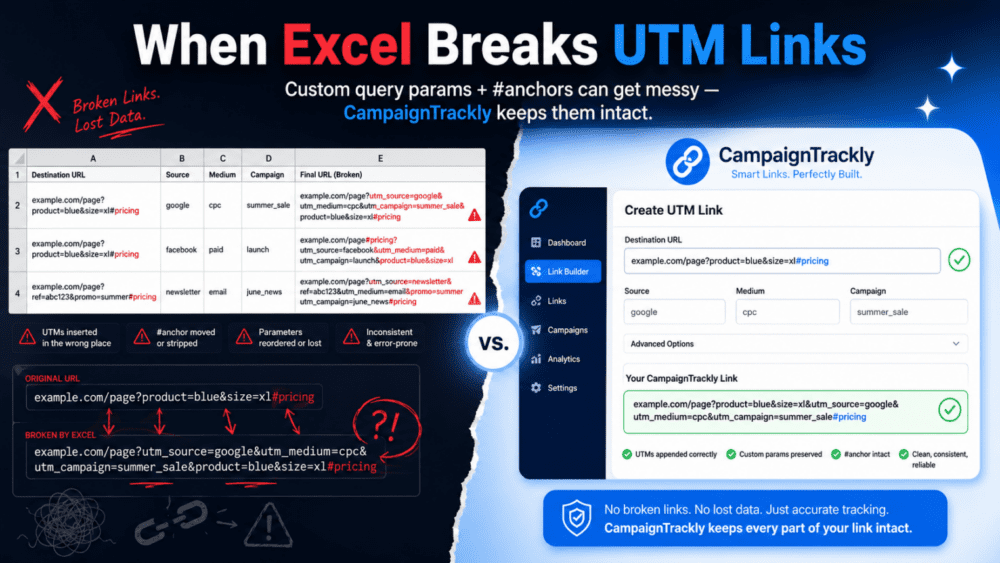
Most teams document naming conventions in a slide deck or spreadsheet and assume people will follow them. In practice, manual utm campaign governance breaks quickly.
Helping You Enforce Campaign Governance Across Your Digital Marketing Links
CampaignTrackly helps enforce campaign naming standards directly inside the workflow by using structured metadata, controlled libraries, medium-to-source mapping, and platform macros on our automated campaign url builder platform. Instead of typing everything manually, marketers select standardized values and generate compliant naming and tracking outputs automatically.
Final Takeaway: Clean Campaign Naming Creates Clean Marketing Data
Campaign naming conventions are not just a formatting exercise. They are the foundation of AI-ready, scalable marketing data.
Why Marketing Attribution Depends on Consistent Campaign Names
When campaign, tactic, asset, and delivery metadata are clearly separated, reporting becomes cleaner, attribution becomes more accurate, and optimization becomes easier.
If you want reliable omnichannel reporting, do not let every team invent its own names. Define the structure once, then generate and distribute it everywhere.