Marketing Taxonomy, Naming Conventions, and Campaign Names – What are these “abstract” terms and do they matter to your bottom line?
Marketing Taxonomy, Naming Conventions, and Campaign Names – Let’s Define What is What
In the world of campaign tracking and analytics, people often use terms like ‘taxonomy’, ‘campaign name’, and ‘naming conventions’ interchangeably. But these are three very different things.
The Core Concept
- Marketing taxonomy defines the template — the elements in a campaign name.
- Naming convention defines the rules and formatting.
- The campaign name is the result of applying both to create a consistent, structured label.
Practical Example
Life without a marketing taxonomy in place
If there is no taxonomy in place, three different team members might decide to name the same marketing campaign in three different ways when building tracking links.
Since Google Analytics doesn’t understand human intent, it will treat the three variants as separate campaigns in reports.
As a result, the team will end up with split campaign reporting, broken grouping in reports, fragmented attribution, and hours of cleanup work after launch.
Life without a naming convention in place
If a team has a great taxonomy in place, but no convention rules, the reports might still get broken if each member formats the same campaign name differently – all caps versus small caps, for example.
Because analytics platforms are case-sensitive and character-specific, a simple font variation or a stray space creates a new, duplicate campaign record.
The goal is not just “better naming.” The goal is a measurement system that creates clean, consistent, analyzable campaign data every time. That is why you need all three layers working together.
The 3 Layers of Campaign Naming for Reporting Purposes
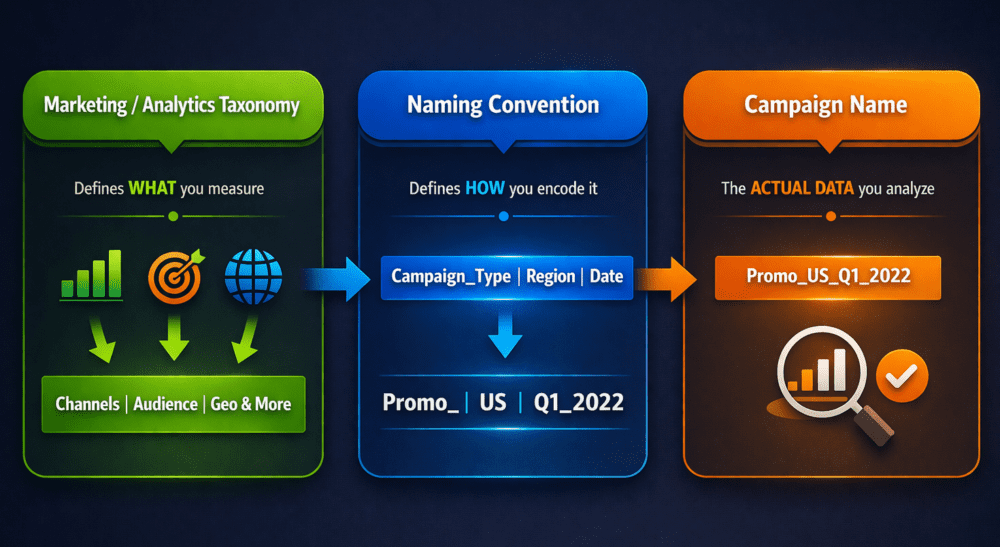
Marketing Taxonomy, Naming Convention, & Campaign Name
1. Marketing / Analytics Taxonomy
What are we measuring?
Taxonomy is your template. It defines the strategic dimensions that matter for your reporting.
✔ Platform
✔ Objective
✔ Audience
✔ Geo/Region
✔ Timeframe
2. Naming Convention
How should we format it?
By contrast, the convention is a set of rules that transform your taxonomy into a consistent, machine-readable label.
channel_platform_objective_audience_geo_date3. Campaign Name
What is the labeled value?
Finally, the campaign name is the actual consistently built and formatted campaign label used in your UTMs and analytics reports.
paid_meta_leadgen_retargeting_us_2026q2Clean Dimensions → Accurate Attribution
Marketing/Analytics Taxonomy: The Template System
Taxonomy defines what metadata or business information goes into each campaign name. It answers the question:
What are we trying to measure?
In campaign analytics, taxonomy often includes dimensions such as:
- Channel — paid, organic, email, social
- Platform — Meta, Google, LinkedIn, Adobe, HubSpot
- Objective — awareness, leadgen, conversion, retargeting
- Audience — prospecting, retargeting, customer, HCP, enterprise
- Geo — US, EMEA, global
- Date — quarter, month, campaign season, launch window
In other words, taxonomy determines the building blocks of measurement. These become the categories that show up in analytics, BI models, and campaign governance.
Naming Convention: The Rule Set
Once you know what you want to measure, you need rules for how those dimensions should appear in a usable label.
That is the job of a naming convention.
A naming convention is the formatting logic that makes campaign labels predictable, machine-readable, and consistent across teams.
It answers the question:
Typical naming convention rules include:
- Use lowercase only
- Use underscores or hyphens consistently
- Keep the same order of dimensions every time
- Avoid special characters and vague abbreviations
- Use approved tokens from the taxonomy
Example naming convention:
channel_platform_objective_audience_geo_dateThis is not the campaign name itself. It is the “grammar” for building one. If you are looking for actual naming formats and examples, read on or see our campaign naming conventions guide.
Campaign Name: The Actual Label or Value
The campaign name is the concrete output. It is the specific campaign label created by applying the naming convention to the taxonomy values.
It answers the question:
What is the actual data point we will analyze in reporting?
Example:
paid_meta_leadgen_retargeting_us_2026q2The campaign name is a compact, structured representation of multiple measurement dimensions:
- paid = channel
- meta = platform
- leadgen = objective
- retargeting = audience
- us = geo
- 2026q2 = time period
In analytics terms, this becomes the label that shows up in your reports, exports, dashboards, and attribution models grouping traffic in measurable buckets. Learn how to name campaigns, tactics, and asset variants here.
TIP: Where in the campaign link would the campaign name go if you are using Google Analytics (GA4), for example?
It is placed in the utm_campaign parameter: utm_campaign=
paid_meta_leadgen_retargeting_us_2026q2.
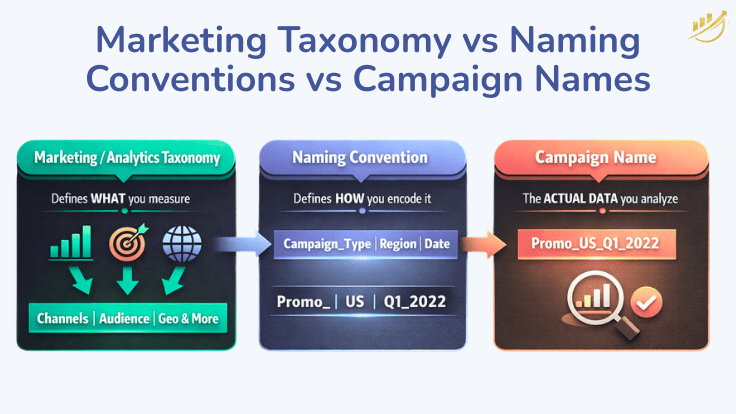
Diagram showing the difference between marketing taxonomy, naming convention, and campaign name in campaign analytics
The Easiest Way to Remember the Three Layers
Taxonomy is the pre-set combination of required campaign name elements.
Naming convention rules how these elements are formatted together.
Campaign Name is what you see in your reporting dashboard.
Example: How They Work Together
Here is the relationship between all three layers:
Taxonomy (elements and order):
channel / platform / campaign objective / audience / geo / date

Naming convention (lower case, separator is "_"):
channel_platform_objective_audience_geo_date

Campaign Name (real-life example):
paid_meta_leadgen_retargeting_us_2026q2
How to Use Each Layer:
| Term | What it means | Best use |
|---|---|---|
| Taxonomy | The classification system and measurement dimensions | Strategy, governance, analytics architecture |
| Naming convention | The rule set for how dimensions are entered in the labels | Implementation, operations, UTMs, campaign setup |
| Campaign Name | The specific label or value created from those rules | Execution, examples, reporting, analysis |
Where Things Might Go Wrong
Many teams jump straight to names without defining taxonomy or name conventions and rules.
Ultimately, this leads to values like:
Paid-Meta-LeadGen-US
meta_retarget_q2
facebook-paid-leads
leadgen_meta_us_retargeting
These may all refer to the same efforts, but they are not consistent enough for clean reporting at scale.
The Hardest Part of Marketing Taxonomy for Analytics Isn’t the Data—It’s the Agreement
- The biggest hurdle in building a marketing taxonomy for analytics isn’t technical; it’s organizational.
- Before you can build a single tracking link, you have to get stakeholders from across the organization to agree on what needs to be measured.
- If teams use different terminology for the same goals, your reporting is broken before it even starts.
Taxonomy is the “strategic consensus”—the agreement on which categories (Campaign, Tactic, Variant) matter most to your business goals and requires both stakeholder and change management.
Why This Matters for Analytics
Analytics platforms do not magically standardize messy campaign inputs. They reflect what you send them.
If taxonomy is unclear, teams measure different things. If naming conventions are inconsistent, teams encode the same thing in different ways. If the final name is sloppy, your reporting becomes fragmented.
This is why clean marketing measurement depends on all three layers working together.
- Taxonomy creates comparable dimensions
- Naming conventions create consistency across execution
- Names create analyzable campaign records
Final Takeaway
The strongest campaign tracking systems do not start with a random name typed into a spreadsheet.
They start with a clear measurement model:
- Taxonomy defines what matters
- Naming convention defines how it should be expressed
- Name becomes the final unit of analysis
Need a Professional, Automated UTM Builder?
CampaignTrackly helps teams create standardized taxonomy, enforce naming conventions, and generate analytics-ready campaign names before bad data reaches your reports.
FAQ
What is marketing taxonomy?
Marketing taxonomy is the classification system used to define the dimensions you want to measure, such as channel, platform, audience, objective, geography, or timeframe.
What is a campaign naming convention?
A campaign naming convention is the rule set that determines how taxonomy values are formatted and combined into a consistent, readable label.
What is the difference between taxonomy, naming convention, and campaign name?
Taxonomy defines what you measure, naming convention defines how you encode it, and the name is the actual label used in execution and reporting.
Why does this matter in analytics?
Because inconsistent classification and labeling create fragmented reporting, unreliable attribution, and harder-to-trust dashboards.
Should taxonomy and naming conventions live on the same page?
They can, as long as the page stays strategic and explanatory. If you already have a separate execution-focused naming guide, use this page to explain the broader system and link to the tactical page for examples.
Pre-Launch Tool
Free 3-Minute GA4 UTM Campaign Tracking QA Checklist
Don’t launch with broken tracking. Use this quick 3-minute guide to validate your UTM parameters and ensure 100% accurate attribution.
The QA Checklist Covers:
👉 Get the 3-Minute QA Checklist
Stop “Unassigned” traffic before it starts.