
Campaign Metadata Governance: The 4-Layer Framework for Reliable Attribution and AI Readiness
In an era where global advertising spend exceeds $1 trillion annually inconsistent campaign metadata is not a formatting issue — it is a financial risk. Campaign tracking errors distort reporting, misallocate budget, and erode executive trust.
Campaign Metadata Governance Is Not Optional — It’s Foundational
Marketing measurement has evolved. What used to be “tactical tagging” is now central to decision-making.
Campaign performance data drives:
- Budget allocation and optimization
- ROI visibility
- Sales forecasting
- Creative impact analysis
- Attribution modeling
- Training inputs for AI systems
Despite modern analytics stacks — GA4, Adobe Analytics, Snowflake, BigQuery, and advanced BI tools — the tracking layer beneath these systems often lacks governance discipline.
This blog breaks down a practical architecture you can implement today to eliminate reporting distortion at scale.
When Metadata Is Not Consistently Governed
- Campaign names fragment
- Paid media macros override canonical identity
- CRM IDs misalign
- Warehouse joins require normalization effort
- Executive dashboards lose reliability
How Complexity Multiplies
Three structural shifts are increasing risk:
1. AI-Driven Campaign Volume
AI increases campaign variation and execution speed. Inconsistent inputs compound faster at scale.
2. Platform-Specific Data Fragmentation
Each marketing platform involved in campaign creation uses different syntax, data schemas, and tracking structures. Without centralized governance, fragmented metadata places reporting accuracy at risk.
3. Warehouse-First Reporting
Snowflake and BigQuery require deterministic join keys. String inconsistencies cannot be manually patched. If campaign identity is unstable, financial reporting becomes unstable.
🔍 What Goes Wrong Without Governance
When campaign metadata is ungoverned:
- Campaign names warp over time
- Paid media macros override canonical values
- Analytics tools split traffic into multiple labeled buckets
- Warehouse joins require manual cleansing
- AI amplifies, rather than corrects, inconsistency
Real example:
A renamed email campaign can go from Spring_Launch_2026 to Spring_Launch_2026_Final. Without a stable identifier, analytics tools treat them as two separate campaigns, leading to:
- “0 clicks” reported
- Split performance across dashboards
- Revenue that does not reconcile in CRM
That’s not data loss — it’s data fragmentation.
Why Common “Solutions” Often Increase Complexity
Spreadsheets, Cheat Sheets, and Link ID Abstraction
At the metadata and campaign url buildingcampaign url building level, many organizations rely on complex spreadsheets to keep campaign data aligned. Others delegate governance entirely to agencies. Some attempt to abstract tracking through additional link ID layers intended to “simplify” URLs.
These partial solutions often introduce:
- Additional infrastructure and cost
- Validation dependencies
- Higher troubleshooting overhead
- Increased total cost of ownership
Link ID Models: Helpful or Overhyped?
Many vendors promise that replacing long parameterized URLs with short IDs solves tracking problems. The reality is more nuanced.
Direct Parameterized URLs
- Native ingestion by GA4 and Adobe
- Simpler debugging
- Lower infrastructure cost
Redirect-Based IDs
- Shorter URLs
- Additional infrastructure
- Extra validation steps
- Higher debugging overhead
Separate ID + Translation Files
- Highest complexity
- Mapping becomes a recurring dependency
- Greater total cost of ownership
Rule of thumb: If you are not forced by compliance or placement constraints (SMS/QR), govern the metadata — do not abstract it away.
Custom-Building Inside Workflow Systems
Some organizations attempt to extend existing platforms like Workfront or Salesforce by embedding metadata logic directly into complex workflow systems.
This often creates:
- Extended implementation timelines (12–18 months)
- Upgrade fragility
- Increased developer dependency
- Greater platform risk
Campaign governance is critical for reporting — but fractional relative to enterprise workflow systems. The optimal approach is to leverage specialized platforms with strong infrastructure and integration layers that ensure smooth cross-platform synchronization.
The Modern Governance Model
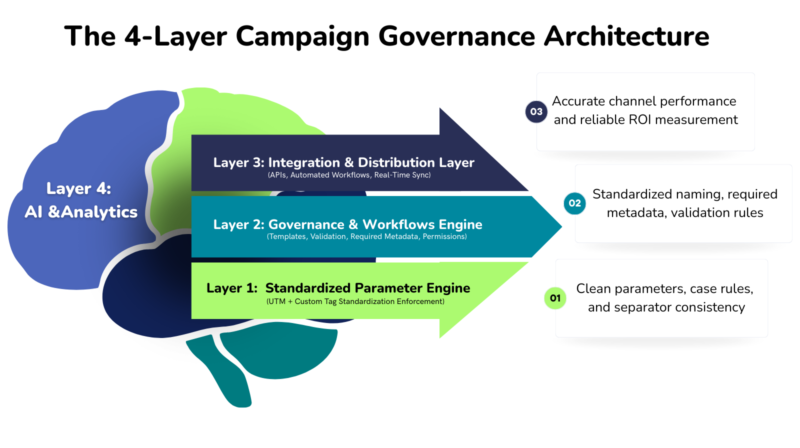
When selecting a campaign governance solution, evaluate it against a structured four-layer framework:
Layer 1 – UTM Tag /CID Parameter Standardization
Enforced UTM/CID structure, immutable identifiers, macro discipline.
Layer 2 – Workflow Enforcement
Templates, required metadata, validation, audit trails.
Layer 3 – Integration & Synchronization
Cross-system identity alignment (CRM, analytics, warehouse).
Layer 4 – AI & Intelligence Readiness
Audit scoring, anomaly detection, orchestration-ready data.
If your chosen solution meets all four layers — and the cost/benefit ratio is favorable — you are on your way to best-in-class campaign governance and optimized reporting.
Executive Takeaway
Campaign metadata governance is not optional. It is the structured data layer that feeds analytics systems, warehouses, and budget decisions.
- Reduces financial distortion
- Protects reporting integrity
- Shortens troubleshooting cycles
- Lowers developer spend
- Enables AI at scale
Campaign metadata and tracking links are no longer a minor detail. When trillions of dollars depend on reliable measurement, ungoverned tracking becomes a financial liability, not an operational annoyance. Use the 4-layer model to select a solution that drives measurable ROI at the right cost/benefit ratio.